 Stetho Cases
Wheeze vs rhonchi: difference, with audio
A wheeze is a high-pitched, musical whistle; rhonchi are low-pitched and sound like snoring. Both are continuous sounds from narrowed or partly blocked airways. Rhonchi often change or clear after a cough, because secretions in larger airways are a common cause; a wheeze usually does not.
Listen to both
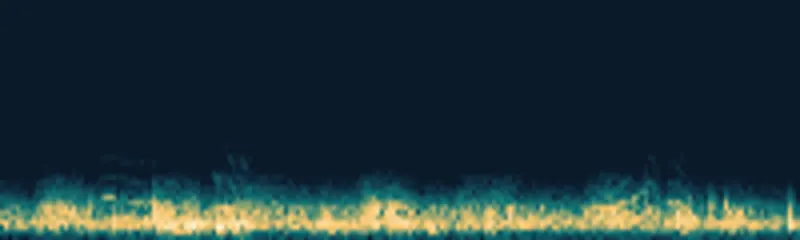 2000 Hz
Source: SPRSound, CC BY 4.0; cut, filtered and levelled.
 2000 Hz
Source: HF_Lung_V1, CC BY 4.0; cut, filtered and levelled.
Side by side
| Wheeze | Rhonchi | |
|---|---|---|
| Pitch | High, musical | Low, snoring |
| Type | Continuous | Continuous |
| Usual phase | Expiration | Either, often expiration |
| After coughing | Usually unchanged | May clear or change |
| Spectrogram | Thin horizontal lines, higher up | Low horizontal band |
What we measured
We measured the stretches that the dataset annotators marked as wheeze (588 marks in 235 clips) and rhonchi (492 marks in 186 clips) in the clips used by Stetho Cases.
| Wheeze | Rhonchi | |
|---|---|---|
| Strongest frequency, median (middle half) | 180 Hz (133–227) | 117 Hz (102–133) |
| Length of a mark, median | 0.71 s | 0.75 s |
Wheeze is clearly higher than rhonchi, but both sit well below the old textbook limits of 400 and 200 Hz. Part of that is the method: the strongest frequency of a whole marked stretch includes low breath noise and heart sounds, and we only looked from 80 to 2,000 Hz. Judge by comparison and by quality (whistle or snore), not by an absolute number. How we measured.
Learn each one
Sources
- Bohadana A, Izbicki G, Kraman SS. Fundamentals of Lung Auscultation. New England Journal of Medicine. 2014;370:744-751.
- Pasterkamp H, Brand PLP, Everard M, et al. Towards the standardisation of lung sound nomenclature. European Respiratory Journal. 2016;47:724-732.
- Hsu FS, Huang SR, Huang CW, et al. Benchmarking of eight recurrent neural network variants for breath phase and adventitious sound detection: HF_Lung_V1. PLOS ONE. 2021;16:e0254134.
- Zhang Q, et al. SPRSound: Open-Source SJTU Paediatric Respiratory Sound Database. IEEE Transactions on Biomedical Circuits and Systems. 2022;16:867-881.